
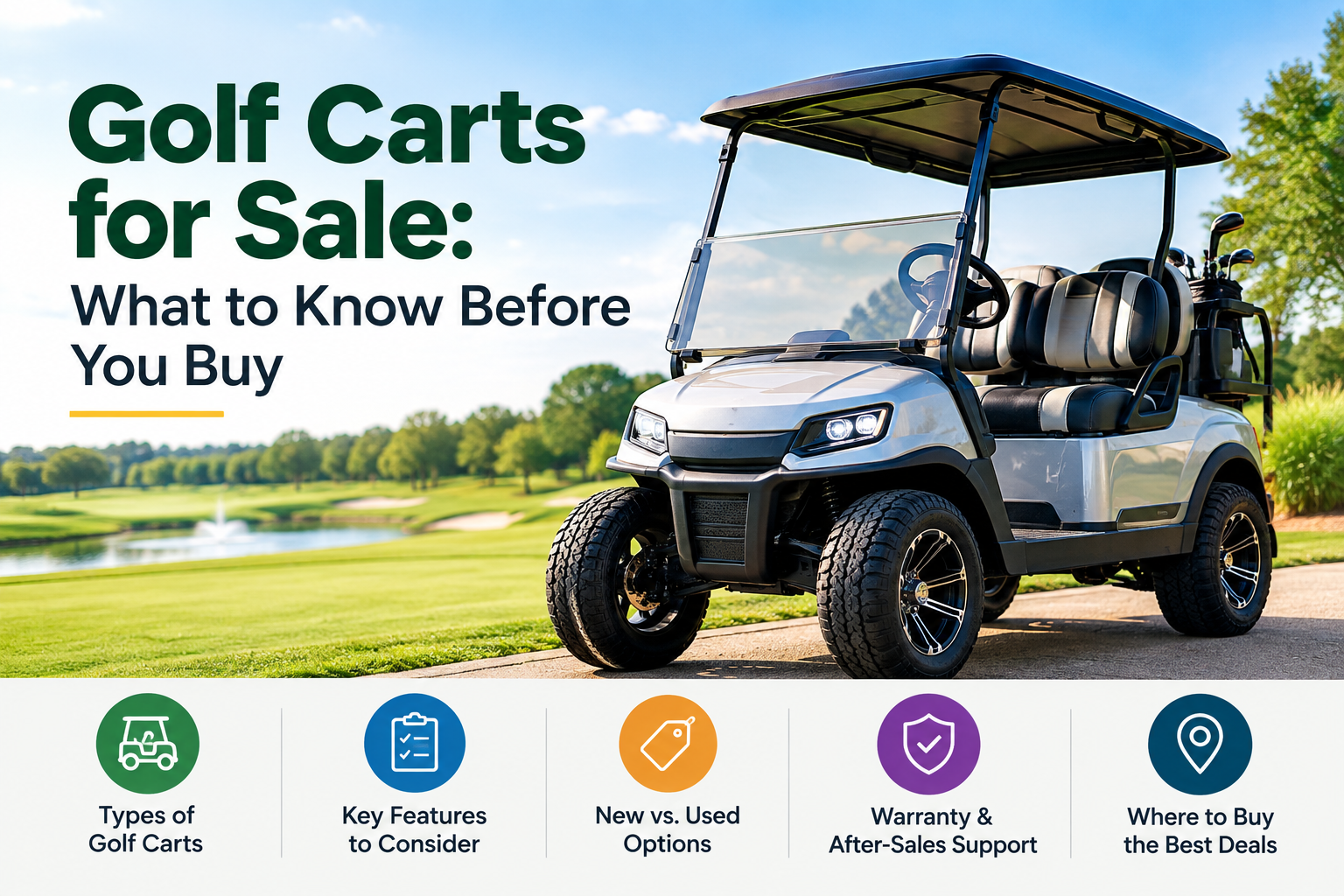
Golf Carts for Sale: What to Know Before You Buy
Shopping for golf carts for sale is no longer simply a matter of choosing between a two-seat or four-seat cart. Today’s buyers can choose from electric and gas powertrains, lithium and lead-acid batteries, multiple seating configurations, street-legal models, utility carts, luxury features, custom wheels and tires, lifted suspensions, and a wide range of new and pre-owned options.
The right golf cart depends on how you plan to use it, where you plan to drive it, how many people you need to carry, and how much you want to spend over the entire ownership period.
At Woody’s Golf Carts, shoppers can explore new and pre-owned golf carts along with brands such as Yamaha, Club Car, ICON, Evolution, E-Z-GO and Atlas. Woody’s also offers service, repairs, parts, accessories and custom upgrades, giving buyers options beyond the initial purchase.
Here’s what you should know before buying.
Start With How You Plan to Use Your Golf Cart
Before comparing brands or colors, determine what you actually need the cart to do.
A golf cart used exclusively on a private property may have very different requirements from one used around a neighborhood or community.
Consider these common uses:
- Golf course use: A compact two- or four-passenger cart may be sufficient.
- Neighborhood transportation: Comfort, range, seating and road-use requirements become more important.
- Campground or resort use: Four- and six-passenger carts can be useful for moving family and guests.
- Large properties: Consider terrain, ground clearance, range and utility features.
- Farm or recreational use: Suspension, tires, cargo capacity and durability may matter more.
- Commercial applications: Consider passenger capacity, operating hours, serviceability and replacement parts.
- Luxury or lifestyle use: Premium seating, technology, lighting, audio, wheels and custom finishes may be priorities.
The key question is simple: What do you expect your golf cart to do most often?
Answering that question first can prevent you from paying for features you do not need—or overlooking features you will wish you had later.
New vs. Used Golf Carts
One of the first decisions you’ll make is whether to purchase new or pre-owned.
Benefits of buying new
A new golf cart gives you access to current models, current technology, new components and manufacturer-backed warranty coverage where applicable.
New can make sense if you want:
- The latest features
- A new battery system
- A specific color or configuration
- Factory options
- Customization from the beginning
- Warranty protection
- The ability to choose your seating arrangement and accessories
New golf carts can also be easier to configure around a particular lifestyle. For example, you might select a four- or six-passenger configuration, upgraded wheels, premium seating, a windshield, lighting or other accessories before delivery.
Benefits of buying used
A pre-owned golf cart can offer a lower purchase price and may be attractive to buyers who want a proven platform without paying the cost of a new model.
However, condition matters.
When looking at a used golf cart, don’t judge the vehicle by its paint, seats or wheels alone. The battery, drivetrain, frame, brakes, suspension, charger and electrical system can have a much greater effect on ownership cost.
A used golf cart with an excellent maintenance history can be a very different purchase from a similar-looking cart with an unknown history.
Electric vs. Gas Golf Carts
The choice between electric and gas should be based on how and where you’ll use your cart.
Electric golf carts
Electric models are popular for neighborhood, residential, recreational and many private-property applications because they operate quietly and have fewer engine-related maintenance requirements.
Modern electric carts may use lithium batteries, while many older or lower-cost carts use lead-acid battery systems.
Electric may be worth considering if you prioritize:
- Quiet operation
- Simple charging
- Lower routine drivetrain maintenance
- Neighborhood and community use
- Modern lithium technology
- A clean, smooth driving experience
Gas golf carts
Gas-powered golf carts can make sense for buyers who prioritize quick refueling, extended use away from charging infrastructure or certain heavy-duty applications.
Gas models require engine-related maintenance, including oil, filters and other service items.
Before choosing gas, consider where you will store the cart and whether you have convenient access to fuel.
Which should you choose?
There isn’t one powertrain that fits every buyer.
If your golf cart will primarily handle short trips around a neighborhood, community or private property, an electric model may fit your needs well.
If you’re planning longer periods of continuous use in locations where charging is inconvenient, gas may deserve consideration.
The important thing is to match the powertrain to your actual usage rather than choosing based solely on what looks popular.
Lithium vs. Lead-Acid Golf Cart Batteries
Battery technology is one of the most important considerations when buying an electric golf cart.
Lead-acid batteries
Lead-acid technology has been used in golf carts for decades and remains common, particularly among older used carts.
The main advantages are familiarity and potentially lower initial cost.
The tradeoff is maintenance. Depending on the battery type, lead-acid systems can require watering, cleaning and other routine care.
Lithium batteries
Lithium batteries have become increasingly common in newer golf carts.
Potential advantages include:
- Lower weight
- Consistent power delivery
- Reduced routine battery maintenance
- Faster charging in some systems
- Modern battery-management technology
- Potentially longer service life depending on the battery and usage
The battery warranty, manufacturer specifications and expected operating conditions should all be reviewed before purchasing.
For a used electric golf cart, always ask about the battery’s age, type, condition, warranty and replacement history.
A low purchase price can become less attractive if the battery system needs replacement soon after purchase.
How Much Do Golf Carts Cost?
Golf cart prices vary substantially depending on age, brand, seating capacity, powertrain, battery technology, accessories, condition and whether the vehicle is street legal.
Current 2026 market research shows that used carts can begin in the low-thousands while newer, premium and custom models can reach well into the five figures.
Woody’s current inventory illustrates that range, with listed examples including older pre-owned Club Car and E-Z-GO models as well as newer Evolution, ICON and EPIC carts.
Instead of asking only, “How much is a golf cart?” ask:
What will this golf cart cost me to own?
Your total budget should consider:
- Purchase price
- Sales tax
- Registration where applicable
- Insurance where applicable
- Battery replacement
- Fuel or electricity
- Tires
- Brake maintenance
- Repairs
- Accessories
- Customization
- Storage
- Delivery
A cheaper cart isn’t necessarily cheaper to own.
Likewise, a more expensive cart isn’t automatically the right choice. The objective is to find the configuration that provides the features, reliability and support appropriate for your use.
How Many Seats Do You Need?
Golf carts commonly come in configurations ranging from compact two-passenger layouts to larger six-passenger and utility-oriented models.
Think beyond how many people live in your household.
Ask yourself:
- How many people will normally ride?
- Will children or guests frequently ride?
- Do you need forward-facing rear seats?
- Will you carry golf equipment or cargo?
- Do you need additional storage?
- Will the cart be used for entertaining?
- Do you need a utility bed?
A two-passenger cart may be ideal for an individual or couple.
A four-passenger cart can provide greater flexibility for families and neighborhood use.
Six-passenger models can make more sense when transporting larger groups is part of the plan.
Choosing the correct seating configuration at purchase can be more practical than trying to change the cart later.
Do You Need a Street-Legal Golf Cart?
This is one of the most important questions to answer before buying.
A golf cart intended for private property is not automatically a street-legal vehicle.
Under federal regulations, a Low-Speed Vehicle (LSV) is a four-wheeled motor vehicle capable of more than 20 mph but not more than 25 mph on a paved level surface and subject to a federal gross vehicle weight limit. Federal requirements include applicable equipment standards under FMVSS 500.
However, state and local laws determine where and how an LSV or golf cart can legally operate.
If you plan to drive on public roads, check the requirements in your state and local jurisdiction before purchasing.
Depending on the jurisdiction and vehicle classification, requirements can involve items such as:
- Headlights
- Taillights
- Turn signals
- Mirrors
- Seat belts
- Windshield requirements
- Horn
- VIN or vehicle identification
- Registration
- Insurance
Do not assume that adding headlights and turn signals to a standard golf cart automatically makes it street legal.
If public-road use is important, tell the dealer before purchasing so you can investigate the appropriate vehicle configuration and local requirements.
What to Inspect Before Buying a Used Golf Cart
If you’re considering a pre-owned golf cart, inspect the mechanical and electrical condition rather than focusing only on appearance.
1. Check the battery
Find out:
- Battery type
- Battery age
- Battery manufacturer
- Installation date
- Warranty status
- Charging behavior
- Service history
For electric carts, battery condition can significantly affect the true value of the vehicle.
2. Inspect the frame
Look underneath the cart for obvious damage, corrosion, cracks or poor-quality repairs.
3. Test the brakes
The cart should stop predictably and without unusual noises or excessive pedal travel.
4. Test steering and suspension
Pay attention to unusual movement, noises, looseness or vibration.
5. Test the charger
A functioning charger is an essential part of an electric golf cart.
6. Test all electrical equipment
Check:
- Lights
- Turn signals
- Horn
- Gauges
- Displays
- USB ports
- Audio equipment
- Accessories
7. Inspect the tires
Look for uneven wear, cracks and damage.
8. Check the serial number or VIN
Verify the vehicle’s identity and model information against the seller’s description and available documentation.
9. Drive the cart
Don’t buy based only on photographs.
Test acceleration, braking, steering, suspension and overall ride quality.
10. Ask for service history
Maintenance records can provide valuable context about previous ownership.
Why Dealer Service Matters
Buying a golf cart is not necessarily a one-time transaction.
Eventually, you may need:
- Battery service
- Brake work
- Tire replacement
- Electrical diagnosis
- Charger repairs
- Suspension work
- Accessory installation
- Preventive maintenance
- Customization
That makes the dealer or service provider you choose an important part of the buying decision.
Woody’s Golf Carts states that it provides sales, service, repairs, parts, accessories and custom builds, serving customers from its Oak Harbor, Ohio location and surrounding Northwest Ohio communities.
For buyers, this creates an important consideration: who will support the cart after you buy it?
A golf cart with strong local service support can be easier to maintain over the long term than one purchased solely because it had the lowest advertised price.
Choosing Brands and Features
Brand selection should come after you understand your requirements.
Woody’s Golf Carts currently lists brands including:
- Yamaha
- Club Car
- ICON
- Evolution
- E-Z-GO
- Atlas
Different manufacturers and models can emphasize different combinations of performance, comfort, styling, technology, utility and customization.
For example, a buyer interested in modern styling and technology may approach the purchase differently from someone searching for an older Club Car or E-Z-GO for straightforward private-property transportation.
The same principle applies to accessories.
Popular customization areas include:
- Lift kits
- Wheels
- Tires
- Lighting
- Windshields
- Seating
- Audio
- Mirrors
- Storage
- Utility equipment
Start with the intended use, then choose features that support it.
Common Golf Cart Buying Mistakes
Buying based only on price
The cheapest cart can become expensive if it needs major repairs or a battery replacement.
Ignoring battery condition
Especially with used electric carts, battery health should be part of the purchase discussion.
Buying too few seats
Think about your normal and occasional passengers before choosing a two-seat configuration.
Assuming every golf cart is street legal
Road-use requirements vary. Verify them before buying.
Choosing accessories before functionality
A great stereo and custom wheels don’t compensate for the wrong powertrain, battery or seating configuration.
Ignoring service availability
Find out who will work on the cart after the sale.
Failing to calculate total ownership cost
Purchase price is only one part of the financial picture.
Golf Cart Buying Checklist
Before purchasing a golf cart, confirm the following:
Usage
- Where will I drive it?
- How frequently will I use it?
- What terrain will it encounter?
Power
- Electric or gas?
- What range do I need?
- What charging or refueling access do I have?
Battery
- Lithium or lead-acid?
- How old is the battery?
- What warranty applies?
Capacity
- Two, four or six passengers?
- Do I need additional cargo space?
Condition
- Frame checked?
- Brakes tested?
- Tires inspected?
- Suspension checked?
- Charger tested?
- Electrical equipment tested?
Legal
- Private property or public roads?
- Does the cart qualify for the road use I need?
- What registration and insurance requirements apply locally?
Ownership
- Who will service it?
- Are parts available?
- What warranty applies?
- What accessories do I actually need?
Financial
- What is the complete out-the-door price?
- Are delivery or setup charges included?
- What future maintenance should I budget for?
Frequently Asked Questions
What should I look for when buying a golf cart?
Focus on intended use, seating, powertrain, battery condition, frame, brakes, tires, suspension, charger, electrical equipment, warranty, service support and total ownership cost.
Is it better to buy a new or used golf cart?
Both can make sense. New carts offer current models and technology, while used carts can provide a lower entry price. Used buyers should pay particular attention to battery condition, mechanical condition and service history.
Are electric golf carts better than gas golf carts?
The answer depends on how you plan to use the cart. Electric models can offer quiet operation and simpler drivetrain maintenance, while gas models can be useful for applications where rapid refueling and extended operation are important.
How long does a golf cart battery last?
Battery life depends on chemistry, usage, charging practices, maintenance, storage and manufacturer specifications. Ask for the battery’s age and warranty rather than relying on a generic lifespan estimate.
Do I need a street-legal golf cart?
Only if you plan to use the cart on public roads where a qualifying vehicle is required. Requirements vary by jurisdiction, so verify your state and local rules before purchasing.
What golf cart brands does Woody’s Golf Carts sell?
Woody’s currently lists Yamaha, Club Car, ICON, Evolution, E-Z-GO and Atlas among its golf cart brands.
Can I customize a golf cart?
Yes. Golf carts can be customized with features such as wheels, tires, lift kits, lighting, seating, mirrors and other accessories. Woody’s also promotes custom builds and upgrades.
Should I buy a two-, four- or six-passenger golf cart?
Choose based on your normal passenger needs, how often you transport guests and whether you need additional cargo or utility capacity.
Final Thoughts
Buying a golf cart is easier when you start with your lifestyle instead of starting with a price tag.
Determine where you will drive, how many people you need to carry, whether you want electric or gas, what battery technology fits your needs, and whether public-road use is part of your plans.
Then compare new and pre-owned golf carts, inspect the condition carefully, understand the total ownership cost and consider the dealer’s service capabilities.
For shoppers looking at golf carts for sale, Woody’s Golf Carts provides access to new and pre-owned models, multiple brands, parts, service, accessories and customization from its Northwest Ohio dealership.
Whether you’re looking for a practical neighborhood cart, a family-friendly six-passenger model, a utility-focused vehicle or a customized premium ride, taking the time to define your requirements before buying can help you select a golf cart that fits your lifestyle for years to come.


