
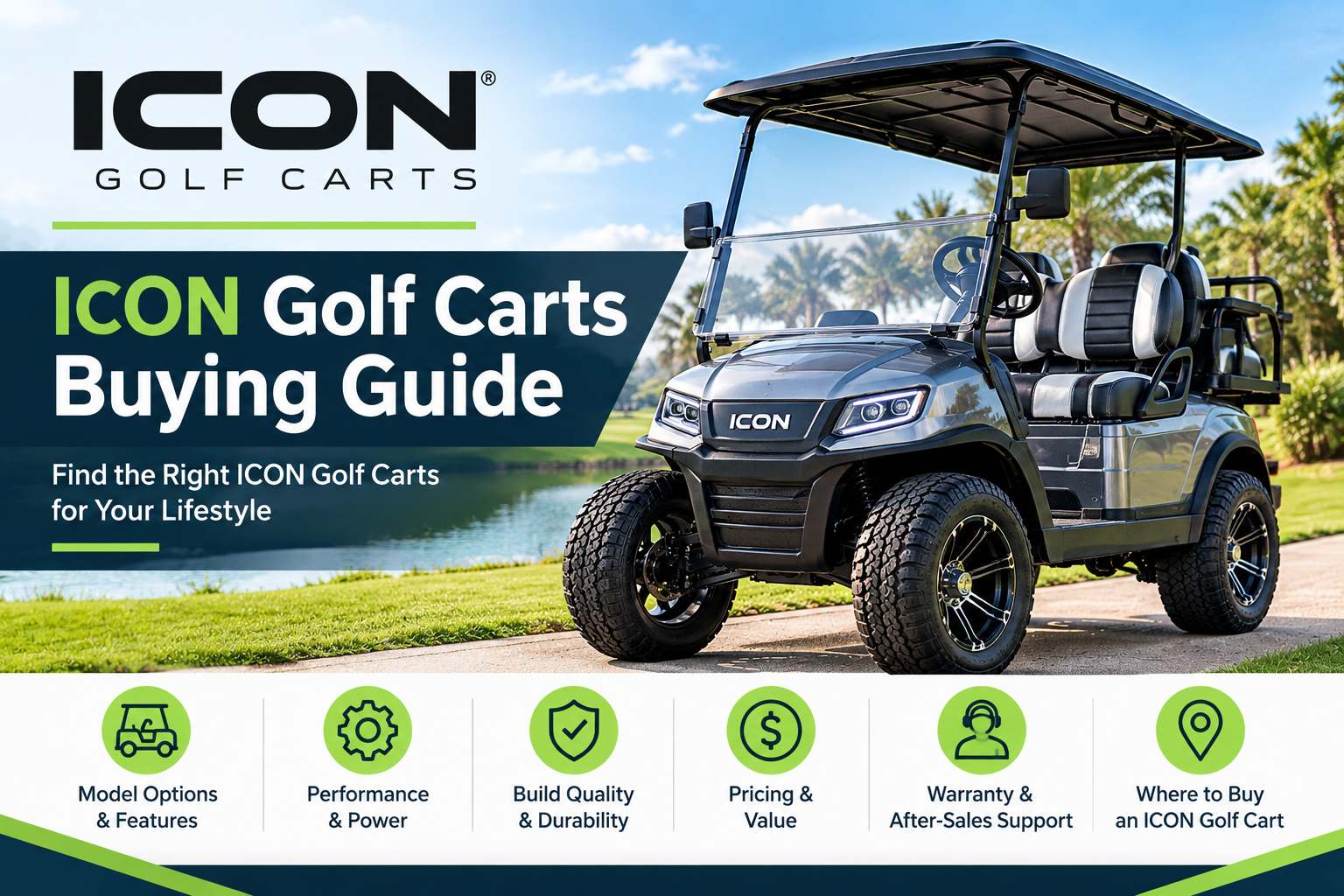
ICON Golf Carts: Complete Buying Guide
ICON has become one of the most talked-about names in golf carts over the past several years — known for loading in lithium batteries, touchscreens, and full street-legal packages as standard equipment, often at a lower price than a comparably equipped legacy-brand cart. That value proposition is real, but so are the trade-offs of buying from a newer manufacturer. This guide covers the full ICON lineup, what actually comes standard, honest pricing, and how ICON stacks up against Club Car, EZGO, and Yamaha — so you can decide if it’s the right cart for you with your eyes open.
Quick answer: ICON golf carts are a strong value pick for buyers who want a fully loaded, lithium-powered, street-legal-ready cart at a lower price than the legacy brands, and who plan to buy from a dealer who will actually stand behind service and warranty support. The trade-off is a shorter reliability track record, a smaller dealer/parts network, and resale value that trails Club Car in particular. ICON is a strong fit for neighborhood and community driving on a budget; buyers prioritizing maximum resale value or a 10+ year ownership horizon should weigh Club Car or Yamaha alongside it.
ICON Golf Carts at a Glance
| Factor | ICON Golf Carts |
|---|---|
| Seating options | 2, 4, 6, and 8-passenger models |
| Typical new price | ~$9,000–$15,500+ depending on model and trim |
| Standard battery | Lithium (commonly 51V/105Ah “Eco Lithium”) on most current models |
| Standard motor | 5kW AC motor with 450A controller on most models (i40-ECO uses a smaller 4kW setup) |
| Top speed | Commonly cited around 25 mph on most models |
| Street-legal package | LSV equipment (seat belts, lights, mirrors, turn signals) standard on i-series/LSV models |
| Brakes | Four-wheel disc brakes on most current models |
| Frame material | Steel |
| Warranty | Manufacturer warranty on cart and battery; terms are typically non-transferable to a second owner — confirm current terms with your dealer |
| Strongest fit | Value-focused neighborhood/community buyers wanting a fully-equipped cart |
| Where it trails legacy brands | Track record, dealer/parts network size, resale value |
Figures are research-based ranges from manufacturer spec sheets and independent reviews, not verified for every current model or trim. Confirm exact specs and current pricing on our ICON commercial inventory page or by contacting us directly.
Who Makes ICON Golf Carts?
ICON Electric Vehicles is based in Tampa, Florida, where carts are assembled, though — like most value-focused golf cart brands — many components are sourced internationally. ICON is a newer entrant compared to Club Car (founded 1958), EZGO, and Yamaha, all of which have been building golf carts for 50+ years. That relative youth is the source of most of the honest trade-offs covered later in this guide: it’s not that ICON builds a bad product, but that the brand doesn’t yet have decades of field data behind it the way the legacy manufacturers do.
Understanding ICON’s Model Names (i20, i40, i60, i80, L, X)
ICON’s naming convention is more logical than it first appears, and understanding it makes comparing models much easier:
- The number = seat count. i20 seats 2, i40 seats 4, i60 seats 6, i80 seats 8.
- “L” = lifted. A longer, lifted version of the same model with more ground clearance and a roomier frame (e.g., i40L, i60L).
- “X” or “LX” = premium trim. The X-series (i20X, i40X, i40FX, i60LX) adds larger wheels, upgraded sound, and additional styling, while sharing the same core motor, controller, and battery as the standard line.
- “F” = forward-facing. Some 4- and 6-seat models (i40F, i60F, i60FS-HD) configure all rows to face forward rather than using a rear-facing bench, which many families with young children prefer.
- “HD” = heavy-duty/commercial. Models like the i60-HD and i60FS-HD step up the motor, controller, and battery capacity for commercial and heavy-use applications.
- “ECO” = entry-level. The i40-ECO uses a smaller motor and simpler brake setup as ICON’s lower-cost entry point.
Across the standard i20, i40, and i60 line, ICON uses the same core drivetrain — a 5kW AC motor and 450A controller — so a larger cart is generally not a slower one; you’re mainly paying for space and trim level, not performance.
The ICON Personal/Neighborhood Lineup
ICON i20 — the 2-seater
ICON’s base model, built for golf, errands, and compact storage. Comes with the full feature set ICON is known for — lithium battery, touchscreen, LED lighting — without the added length or price of the larger models.
ICON i40 / i40L — the 4-seater
The most popular size in the ICON lineup, and for good reason: it comfortably handles two adults and two kids, or two couples, while remaining manageable to store and maneuver. The i40L adds a lifted stance and extra ground clearance over the standard i40. The i40-ECO trims the motor and brake package slightly to hit a lower price point for budget-focused buyers.
ICON i60 / i60L — the 6-seater
Built for larger families, frequent guests, or commercial/hospitality use. Some i60 configurations offer forward-facing seating throughout (i60F) rather than a rear-facing third row, which is worth asking about if ride comfort for all passengers matters to you.
ICON i80 — the 8-seater
ICON’s largest personal model, seating eight. Independent reviews report higher top speeds on the i80 in some configurations — treat any specific speed claim above the commonly cited 25 mph figure with some caution and confirm current specs directly with ICON or your dealer, since figures can vary by battery and configuration.
The ICON Commercial and Utility Lineup
Beyond the personal i-series, ICON offers a dedicated commercial and utility line aimed at resorts, campuses, security patrols, and maintenance work — including the C20S (a nimble 2-seater work cart), C20U and C20UL (utility configurations with cargo capability), C40L (a lifted 4-seater for larger properties), and heavy-duty HD models like the i60-HD and i60FS-HD, which pair upgraded lithium battery capacity and controllers with either passenger seating or a combined passenger-and-cargo-box layout. If you’re outfitting a property or fleet rather than buying a single personal cart, this line is worth a dedicated look — browse ICON commercial golf carts for current availability.
What Comes Standard on an ICON
ICON’s core pitch is that features other brands charge extra for come standard, and that generally holds up across current models:
- Lithium battery (commonly 51V/105Ah) rather than lead-acid as the base option
- A touchscreen display (around 10 inches on current models)
- LED lighting package
- Four-wheel disc brakes
- Full LSV street-legal equipment — seat belts, mirrors, turn signals — on i-series/LSV-classified models
This is the strongest part of ICON’s value case: a comparably equipped Club Car, EZGO, or Yamaha often costs more once you add lithium batteries and a street-legal package as options.
ICON Pricing: What to Expect
Most current ICON models land in the roughly $9,000–$15,500+ range new, depending on seat count, trim, and battery configuration, with the i40-ECO typically the most affordable entry point and larger, higher-trim, or heavy-duty commercial models at the top end. As always, treat any specific number as a starting point rather than a quote — confirm current pricing on our Shop page or by contacting us directly, since configuration and available inventory affect the final price.
ICON vs. Club Car, EZGO, and Yamaha
It’s worth being direct about how ICON compares to the legacy brands, since this is the comparison most buyers are actually making:
| Factor | ICON | Club Car | EZGO | Yamaha |
|---|---|---|---|---|
| Track record | Newer entrant (roughly 5–10 years in the US market) | 65+ years | 50+ years | 50+ years |
| Standard features | Lithium, touchscreen, LSV package often standard | Often optional/extra cost | Often optional/extra cost | Often optional/extra cost |
| Frame material | Steel | Aluminum (DS/Precedent/Onward lines) — resists rust | Steel | Steel |
| Dealer/parts network | Smaller | Larger, established | Larger, established | Larger, established |
| Resale value | Trails the legacy brands, particularly Club Car | Generally strongest | Strong | Strong, often best of the “Big 3” |
| Best known for | Value and standard features | Durability and resale | Rugged utility/commercial use | Quiet, refined ride |
None of this means ICON is a bad choice — it means the decision comes down to priorities. If getting the most standard equipment for the lowest upfront price matters most, ICON is compelling. If maximum resale value, the largest parts network, or a multi-decade track record matters more, the legacy brands have the edge.
The Honest Trade-Offs: What ICON Buyers Should Know
To give this guide real credibility, here are the trade-offs worth knowing before you buy:
- Shorter track record. ICON has been in the US market for roughly 5–10 years, compared to 50+ for Club Car, EZGO, and Yamaha — long-term durability data is still developing.
- Warranty transferability. ICON’s manufacturer warranty terms are commonly non-transferable to a second owner — a real factor if you might sell the cart before the warranty period ends. Confirm exact terms at the time of purchase.
- Resale value. Independent estimates suggest ICON carts retain a smaller percentage of their original value after a few years compared to Club Car in particular. This matters more if you plan to sell or trade in within 5 years than if you’re keeping the cart long-term.
- Dealer and parts network size. ICON’s dealer network is smaller than the legacy brands’ — which makes choosing a responsive local dealer, rather than the brand alone, an important part of the decision. This is also why registering your cart and battery promptly (covered below) matters more with ICON than with a brand where any dealer down the street can help.
- Steel frame. Unlike Club Car’s aluminum-framed DS/Precedent/Onward lines, ICON uses a steel frame, which carries a higher risk of corrosion over time in humid or coastal climates — less of a concern in Northwest Ohio’s inland climate, but worth knowing.
Warranty and Battery Registration — Don’t Skip This Step
A recurring theme in ICON owner complaints isn’t the hardware itself — it’s registration and warranty-claim responsiveness. Battery and cart warranty coverage typically depends on the cart being registered correctly with the manufacturer at the time of purchase. If you experience reduced range, a charging fault, or a battery that won’t reach a full charge, that can stem from several different sources — the battery, the charger, wiring connections, or registration status — so a proper diagnosis matters before assuming a full battery replacement is needed. Buying through a dealer who handles this registration process for you and stays responsive on warranty claims meaningfully reduces this risk — it’s one of the most important reasons to choose your dealer carefully with a newer brand like ICON, not just the model.
Is an ICON Golf Cart Street Legal?
ICON’s i-series and LSV-classified models ship with the equipment needed for low-speed vehicle (LSV) classification — seat belts, headlights, turn signals, and mirrors — as standard. That equipment is necessary but not sufficient on its own: as covered in our electric vs. gas golf cart guide, actual road legality in Ohio depends on the cart’s registration, titling, and your local municipality’s ordinances, not just the equipment on the cart. Confirm your specific local rules before assuming any golf cart, ICON included, is road-ready out of the box.
Who Should (and Shouldn’t) Buy an ICON
ICON is a strong fit if you:
- Want lithium batteries, a touchscreen, and street-legal equipment standard rather than paying extra for them
- Are budget-focused and want the most equipped cart for the price
- Plan to keep the cart for personal/neighborhood use rather than a large resale-focused fleet
- Are buying from a dealer you trust to handle registration and warranty support
Consider Club Car, EZGO, or Yamaha instead if you:
- Prioritize maximum resale value above equipment level
- Plan to keep the cart 7–10+ years and want the deepest track record
- Need the broadest possible dealer and parts network for long-term service
- Are buying in a climate where an aluminum, rust-resistant frame is a meaningful advantage
ICON Models Available at Woody’s
Woody’s Golf Carts carries ICON alongside Yamaha, Club Car, Evolution, E-Z-GO, and Atlas, including ICON’s commercial and utility lineup — models like the C20S, C20U, C20UL, and i60-HD are typically in stock, alongside personal models like the i40L. Since ICON inventory changes, browse our current ICON selection or contact our team to confirm what’s available and get help comparing an ICON against our other brands side by side. If you’re weighing seat count as part of the decision, our 2 vs. 4 vs. 6-seater guide breaks down sizing independent of brand.
FAQ
Are ICON golf carts good?
ICON golf carts are generally well-regarded for value — they come loaded with features like lithium batteries, touchscreens, and street-legal equipment that cost extra on many legacy-brand carts. The trade-offs are a shorter reliability track record, a smaller dealer network, and resale value that trails Club Car in particular. For buyers focused on upfront value and standard equipment, ICON is a strong option; for buyers prioritizing maximum long-term resale value, Club Car or Yamaha may be a better fit.
What does the “L” mean in ICON model names like i40L?
“L” indicates a lifted version of the base model — a longer frame with more ground clearance and additional room compared to the standard version (e.g., the i40L versus the standard i40).
How fast do ICON golf carts go?
Most current ICON models are commonly cited around 25 mph, which fits the low-speed vehicle (LSV) classification. Some sources report higher figures for specific configurations of the i80; confirm exact top speed for any specific model and battery configuration with your dealer before relying on it.
Are ICON golf carts street legal?
ICON’s i-series and LSV-classified models come standard with the equipment needed for low-speed vehicle classification — seat belts, lights, mirrors, and turn signals. Actual road legality still depends on proper registration, titling, and your local municipality’s ordinances, so confirm your specific local rules separately from the equipment on the cart.
How does ICON compare to Club Car?
Club Car generally has the longer track record, an aluminum frame that resists rust, a larger dealer network, and stronger resale value. ICON typically offers more standard equipment (lithium battery, touchscreen, street-legal package) at a lower starting price. The right choice depends on whether you prioritize upfront value and features or long-term resale and dealer network size.
Is the ICON warranty transferable if I sell the cart?
ICON’s manufacturer warranty terms are commonly non-transferable to a second owner, which is worth knowing if you might sell the cart before the warranty period ends. Confirm the exact current terms with your dealer at the time of purchase, since policies can change.
What’s the difference between the ICON i40 and i40L?
Both seat four passengers. The i40L is a lifted version with more ground clearance and a roomier frame compared to the standard i40, which sits lower and has a more compact footprint.
Does ICON make commercial or utility golf carts?
Yes. ICON’s commercial line includes models like the C20S, C20U, C20UL, C40L, and heavy-duty HD models such as the i60-HD and i60FS-HD, aimed at resorts, campuses, security patrols, and property maintenance rather than personal neighborhood use.
The Bottom Line
ICON has earned its place as a serious option in the golf cart market by including features — lithium batteries, touchscreens, street-legal equipment — as standard that cost extra on many legacy-brand carts. That makes it a genuinely strong value pick for neighborhood and community driving, especially if you’re buying from a dealer who will register your cart properly and stand behind service after the sale. Just go in clear-eyed about the trade-offs: a shorter track record, a smaller parts network, and resale value that trails Club Car in particular. For most buyers focused on getting a fully-equipped cart without paying extra for the equipment, that trade-off is worth making.
Curious whether an ICON fits your needs, or want to compare it side by side with our Club Car, EZGO, and Yamaha inventory? Browse ICON golf carts at Woody’s Golf Carts in Oak Harbor, or contact our team — we’ll walk you through current models, pricing, and warranty registration so you know exactly what you’re getting.


