
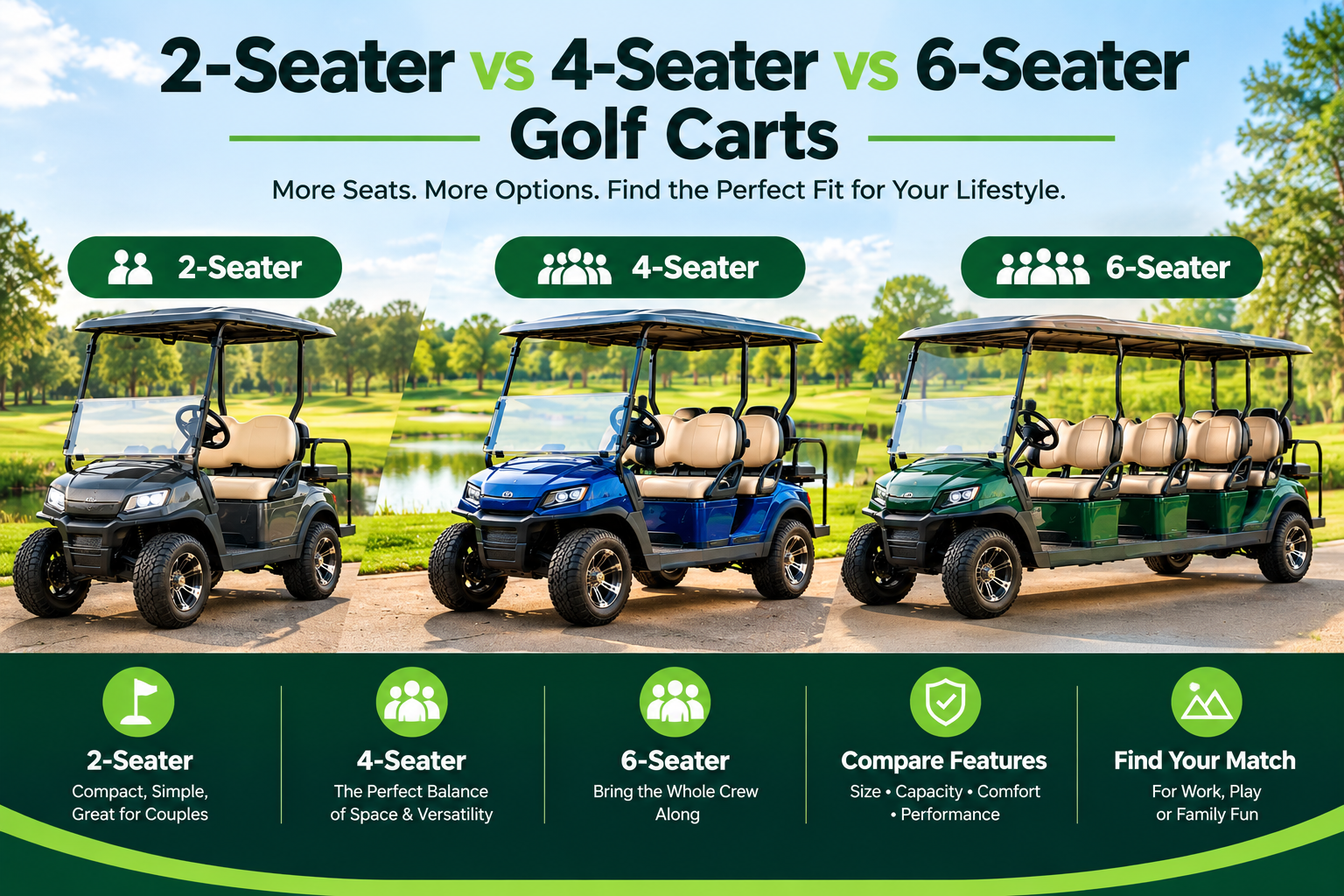
2-Seater vs 4-Seater vs 6-Seater Golf Carts: Which Fits You?
The number of seats on a golf cart affects far more than how many people can ride along — it changes the cart’s length, weight, turning radius, price, battery needs, and even whether it fits your garage or trailer. Getting seat count right up front saves you from either paying for space you don’t use or constantly leaving someone behind.
Quick answer: A 2-seater is the most compact, affordable, and maneuverable option, best for golf, errands, and one or two riders. A 4-seater is the most versatile and most popular configuration, covering families, guests, and light hauling without a major size jump. A 6-seater makes sense when five or six people regularly ride together — think large families, resort or venue use, or hosting frequent group outings — but it costs more, takes up significantly more space, and needs a bigger battery bank.
Here’s how the three sizes actually compare, so you can match the cart to how many people you’ll really carry, not just how many you might carry once a year.
Golf Cart Seating Sizes at a Glance
| Factor | 2-Seater | 4-Seater | 6-Seater |
|---|---|---|---|
| Passenger capacity | 2 | 4 | 6 |
| Typical length | ~91–96 in (about 8 ft) | ~9–10.5 ft | 12+ ft |
| Typical width | ~47–49 in | ~47–49 in | Similar, sometimes wider utility versions |
| Seating layout | Single front bench | Front bench + rear bench (forward or rear-facing) | Two rear rows, often with a rear-facing third row |
| Typical new price | Lower end of the market | ~$1,500–$3,000 more than a comparable 2-seater | Highest, often $3,000+ more than a 4-seater |
| Battery bank (electric) | 4–6 batteries | Similar to 2-seater or slightly more | 6–8 batteries |
| Garage footprint | Smallest — fits most single-bay garages easily | Comfortable in a standard garage | May need extra depth or a dedicated bay |
| Best for | Golf, errands, 1–2 riders, tightest spaces | Families, guests, most neighborhood/community use | Large families, resorts, venues, frequent group outings |
| Market share (used listings) | ~29% | ~48% (most popular) | ~4% |
Figures are research-based ranges drawn from industry and dealer-listing data, not verified for every make and model. Confirm current pricing and dimensions on our Shop page.
2-Seater Golf Carts: The Original Format
The 2-seater is the classic golf cart format — a single front bench seating two, with room behind for golf bags or light cargo. It’s what most people picture by default, and it’s still the standard on golf courses because of its compact footprint, light weight, and tight turning radius. At roughly 8 feet long and under 4 feet wide, a 2-seater fits into almost any garage, storage shed, or tight parking spot, and it’s the easiest of the three sizes to maneuver on narrow paths or in crowded driveways.
If you’re mainly golfing, running errands, or driving solo or as a couple, a 2-seater covers the need without paying for space or battery capacity you won’t use.
4-Seater Golf Carts: Rear Seat Kit vs. Factory-Stretched Chassis
The 4-seater is the best-selling configuration on the market, and it comes in two genuinely different designs worth understanding before you buy:
- Rear seat kit on a 2-seater frame: A rear-facing bench bolted onto the back of a standard 2-seater chassis, in the space that would otherwise hold golf bags or cargo. This keeps the cart’s overall length close to a 2-seater’s, preserving its tight turning radius, but rear passengers typically ride facing backward and the cargo area is reduced or eliminated when the seat is up. Many kits flip down to restore a flat cargo bed when not in use.
- Factory-stretched 4-passenger chassis: Built from the ground up with two forward-facing rows and a longer wheelbase. This delivers a smoother, more stable, more car-like ride, but at the cost of a longer overall footprint and a wider turning radius.
Both configurations seat four — the difference is ride comfort and maneuverability versus a smaller footprint. If you already own a 2-seater and want to add capacity, a rear seat kit is typically the more affordable route; if you’re buying new and comfort for all four riders matters most, a factory-stretched model is usually the better long-term choice.
6-Seater Golf Carts: When You Need the Extra Row
A 6-seater adds a third row — most commonly a rear-facing jump seat, though some premium models now offer all-forward-facing seating for a smoother, more car-like ride. This size is worth considering if five or six people regularly travel together: large families, frequent guests, resort and venue shuttle use, or anyone who’s tired of running two trips instead of one.
The tradeoffs are real: a 6-seater is meaningfully longer (often 12+ feet), heavier, needs a larger battery bank to move that extra length and weight, and costs noticeably more than a 4-seater. For occasional group outings, it’s often more cost-effective to run a 4-seater and make a second trip than to buy, store, and charge a 6-seater year-round.
Dimensions and Garage Fit by Seat Count
Before buying up in seat count, measure your actual storage space:
- 2-seater: About 8 ft by 4 ft of floor space, plus room to walk around it and plug it in if electric. Fits comfortably in nearly any single-car garage bay.
- 4-seater: Roughly 9–10.5 ft long. Still fits a standard garage bay, but leaves less clearance on either side, especially with mirrors or a roof installed.
- 6-seater: 12+ feet long. Many single-car garages won’t comfortably fit a 6-seater with room to walk around it — measure your specific space, including door height if the cart has a roof, before assuming it will fit.
Width stays fairly consistent across all three sizes (roughly 47–49 inches) except for some wider utility or commercial models, so length and garage depth are usually the deciding factor, not width.
Trailering and Hauling by Seat Count
If you’ll ever need to move the cart by trailer or truck:
- A 2-seater (around 400–500 lbs) can sometimes fit in a full-size truck bed with proper strapping, though a ramp is strongly recommended for loading.
- 4-seaters and 6-seaters are heavier and longer, and generally need at minimum a 5×9-foot utility trailer rather than a truck bed.
- Some wider utility-configured carts exceed standard trailer width guidelines — always check your specific cart’s dimensions against your trailer before hauling.
Price and Cost-Per-Seat
New 4-seaters typically run $1,500–$3,000 more than a comparable 2-seater from the same brand, and 6-seaters carry a further, often larger, jump on top of that. Looked at as cost-per-seat, a 2-seater and a well-optioned 4-seater often land in a similar range, while a 6-seater tends to cost more per seat — you’re paying for the extra frame length, third row, and larger battery bank, not just two more seats. That math matters most if you’re weighing a 6-seater against simply running two smaller carts, which can carry the same total passengers for a comparable or lower combined cost.
Browse current pricing across pre-owned golf carts for sale and new inventory to compare real numbers by seat count.
Range, Battery Bank Size, and Weight
Seat count affects electric range more than most buyers expect, because more seats mean more frame, more weight, and typically a bigger battery bank to compensate:
- 2-seaters commonly run on 4–6 batteries.
- 6-seaters often need 6–8 larger batteries to maintain reasonable range with the added length and passenger weight.
A fully loaded 6-seater will generally use more energy per mile than a 2-seater, and a bigger battery bank also means a bigger, more expensive replacement bill down the road — worth factoring into the same battery-chemistry math covered in our electric vs. gas golf cart guide.
Seatbelts and Ohio Road-Legal Requirements by Seat Count
Seat count itself doesn’t determine whether a cart is street legal in Ohio — that comes down to the low-speed vehicle (LSV) vs. under-speed vehicle classification covered in our electric vs. gas golf cart guide — but it does affect what equipment you need. LSV-certified carts require seat belts for every seating position, so a 6-seater built or converted for road use needs seat belts across all six positions, not just the front row. Aftermarket rear seat kits often sell seat belts and rear lighting as separate add-ons rather than including them standard, so if you plan to drive a converted cart on public roads, confirm those components are installed and meet your local requirements before assuming the cart is road-ready. Check our Frequently Asked Questions page for more on what “street legal” actually requires.
Should You Buy Bigger or Add a Rear Seat Kit Later?
If you already own a 2-seater and only occasionally need extra capacity, a rear seat kit is usually the more budget-friendly path — aftermarket kits commonly run a few hundred dollars installed, well below the price difference of buying a new 4-seater outright. The tradeoff is ride quality and resale: a bolted-on rear seat rides differently than a factory-stretched chassis, and buyers shopping used carts often view a factory 4- or 6-seater as a more finished product than a retrofit.
If you’re buying new and know you’ll regularly carry more passengers, it’s usually worth buying the seat count you need from the start rather than planning to upgrade later — particularly for 6-seaters, where the frame, suspension, and battery bank are typically purpose-built rather than something you can add after the fact.
Resale Value by Seat Count
4-seaters are the best-selling used configuration by a wide margin, which tends to make them the easiest to resell and the most liquid segment of the market. 6-seaters make up a much smaller share of used listings — a great fit if you genuinely need the capacity, but worth knowing that your resale pool will be smaller than it would be for a 4-seater. 2-seaters remain a steady, popular segment as well, particularly for golf-focused buyers.
Which Size Fits Your Situation?
| If you mainly… | Consider… | Why |
|---|---|---|
| Golf or run solo/couple errands | 2-seater | Smallest footprint, easiest to maneuver and store |
| Drive with a spouse and occasional guest | 2-seater + rear seat kit, or a 4-seater | Budget-friendly way to add capacity, or buy factory comfort from the start |
| Have a family of 3–4 or regularly host one guest | 4-seater | Best balance of capacity, price, and footprint; easiest to resell |
| Regularly transport 5–6 people together | 6-seater | Avoids repeat trips; worth the extra length, weight, and cost |
| Run a resort, venue, or rental fleet | 6-seater (or a mixed fleet) | Reduces trips and driver count for high-passenger-volume operations |
| Have a single-car garage or tight storage | 2-seater or 4-seater | 6-seaters often don’t fit comfortably with clearance to spare |
Seating Configurations Woody’s Carries
Woody’s Golf Carts stocks 2, 4, and 6-passenger configurations across Yamaha, Club Car, ICON, Evolution, E-Z-GO, and Atlas, including 2+2 layouts (like the EZGO RXV and TXT, and Yamaha Drive 2, all offered as 2+2 models) and larger configurations within the Evolution D5 Series and broader Evolution and Epic lineups. For commercial or high-passenger-volume needs, our ICON commercial and Club Car options are worth a look, and if you already own a cart and want to add capacity, browse rear seat kits and accessories or contact us to confirm fitment for your specific model.
FAQ
How many seats does a golf cart need?
It depends on how many people you regularly transport, not how many you might carry occasionally. Most buyers do best with a 2-seater for solo or couple use, a 4-seater for families or regular guests, and a 6-seater only if five or six people ride together often enough to justify the extra size, weight, and cost.
Can I convert a 2-seater golf cart into a 4-seater?
Yes. A rear seat kit bolts onto the cargo area of most 2-seater carts, converting them into a 4-passenger configuration, typically for a few hundred dollars installed. The seat is usually rear-facing and often flips down to restore cargo space when not needed. Fitment is model-specific, so confirm compatibility with your exact make and model before ordering.
What’s the difference between a rear seat kit and a factory 4-seater?
A rear seat kit adds a rear-facing bench to an existing 2-seater frame, keeping the cart’s compact footprint but with a smaller cargo area and typically a rear-facing ride. A factory-stretched 4-seater is built with a longer wheelbase and two forward-facing rows from the start, delivering a smoother, more car-like ride at the cost of a longer overall footprint and wider turning radius.
Will a 6-seater golf cart fit in my garage?
Maybe — measure first. Many single-car garages comfortably fit 2- and 4-seaters, which typically run 8 to 10.5 feet long, but 6-seaters often exceed 12 feet and may not leave enough clearance to walk around the cart or open doors fully. Measure your specific space, including door height if the cart has a roof, before assuming a 6-seater will fit.
Do 6-seater golf carts cost more to run than 4-seaters?
Generally, yes. A 6-seater’s added length and weight typically require a larger battery bank (often 6–8 batteries versus 4–6 for smaller carts), which increases both energy use per mile and the eventual cost of battery replacement.
Do all six seats on a 6-seater golf cart need seatbelts to be street legal?
If the cart is certified as a low-speed vehicle (LSV) for road use, yes — LSV standards require seat belts at every seating position, not just the front row. If you’re converting a cart with an aftermarket rear seat kit for road use, confirm seat belts and rear lighting are installed and meet your local requirements, since these are often sold separately from the seat kit itself.
Is a 4-seater or 6-seater golf cart easier to resell?
A 4-seater is typically easier to resell — it’s the most in-demand configuration on the used market by a wide margin. 6-seaters make up a much smaller share of used listings, which can mean a smaller pool of buyers when it’s time to sell, even though they’re the right choice for buyers who genuinely need the extra capacity.
What’s the cheapest way to add seating to my golf cart?
For most owners, an aftermarket rear seat kit is the most budget-friendly way to go from 2 to 4 seats, typically running a few hundred dollars installed versus the larger price difference of buying a new factory 4-seater outright. It’s a good option if your need for extra seating is occasional rather than constant.
The Bottom Line
Seat count is one of the first decisions in buying a golf cart, and it’s worth getting right — the difference between 2, 4, and 6 seats affects price, garage fit, battery needs, and how the cart actually feels to drive. Start with how many people you genuinely carry on a regular basis, not the maximum you could imagine carrying once, and size up only if that number is consistently more than your current cart handles.
Not sure which size fits your driveway, garage, or family? Browse 2, 4, and 6-seater golf carts at Woody’s Golf Carts in Oak Harbor, or contact our team — we can help you measure your space, compare seating layouts in person, and figure out whether a rear seat kit or a factory-built model is the better fit for how you’ll actually use it.


