
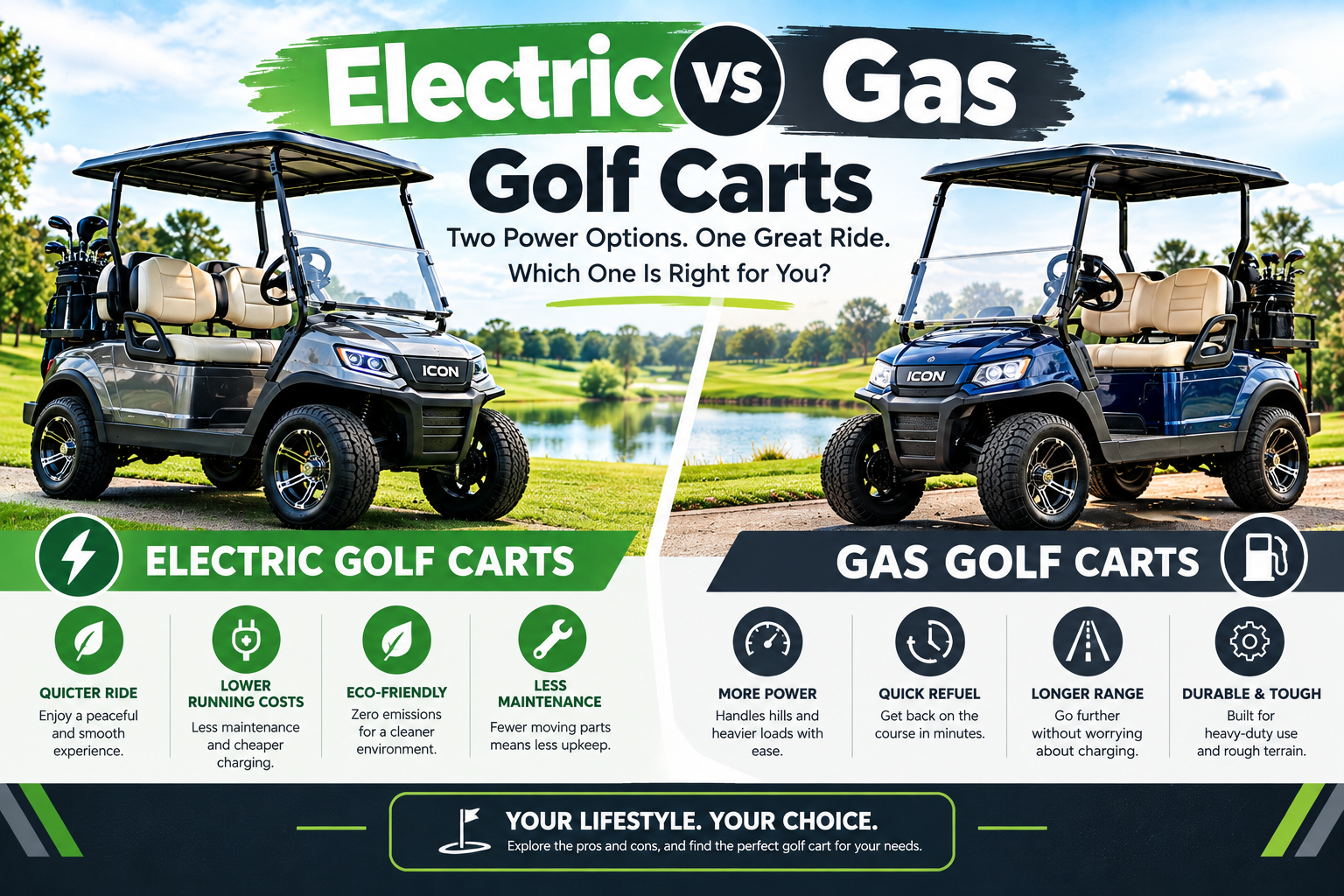
Electric vs Gas Golf Carts: Which Is Right for You?
Choosing between an electric and a gas golf cart comes down to three things: how you’ll use it, what you’re willing to spend over time, and what’s actually allowed where you live. Neither type is universally “better” — each wins in different situations.
Quick answer: Electric golf carts are the better fit for most neighborhood, HOA, and golf-course driving — they’re quieter, cheaper to run day to day, and increasingly powerful enough for hills thanks to modern AC motors and lithium batteries. Gas golf carts still make sense for large rural properties, heavy hauling, long-distance utility work, or anywhere you can’t easily charge overnight.
The rest of this guide breaks down the cost, performance, legal, and practical differences so you can match the cart to your actual driving needs — not just the sticker price.
Electric vs. Gas Golf Carts at a Glance
| Factor | Electric Golf Cart | Gas Golf Cart |
|---|---|---|
| Typical new price | ~$8,000–$14,000+ | ~$9,000–$14,000+ |
| Fuel/energy cost | About $0.02/mile to charge | About $0.10–$0.15/mile in fuel |
| Annual maintenance | Roughly $50–$200 | Roughly $200–$500 |
| Noise level | Near-silent (50–60 dB) | Audible engine noise (70–85 dB) |
| Range per fill/charge | 25–60+ miles (battery-dependent) | 100–200+ miles per tank |
| Power | 3–7 hp typical; modern AC motors rival gas on hills | 10–12 hp typical; strong on steep or rough terrain |
| Emissions | Zero direct emissions | Combustion exhaust |
| Best for | Neighborhoods, golf courses, HOAs, daily short trips | Large properties, heavy hauling, remote/off-grid use |
| Biggest long-term cost | Battery replacement every 4–10 years depending on chemistry | Ongoing fuel, oil, filters, spark plugs |
Figures are research-based ranges drawn from manufacturer and industry sources, not verified for every make and model. Confirm current pricing on our Shop page.
How Electric and Gas Golf Carts Actually Work
Electric golf carts
An electric golf cart uses a battery pack (typically 36V, 48V, or 72V) to power an electric motor, which turns the wheels through a simple drivetrain with far fewer moving parts than a combustion engine. You plug it in to recharge, generally overnight, and modern AC-motor systems deliver smooth, near-instant torque.
Gas golf carts
A gas golf cart runs on a small combustion engine — usually a single-cylinder four-stroke — fueled from an onboard tank, similar in concept to a small engine on a lawn mower or ATV. Power reaches the wheels through a belt-driven transmission. You refuel at a gas station or with a portable can, and a full tank typically lasts far longer between fill-ups than an electric cart’s charge.
Upfront Cost: What You’ll Actually Pay
Purchase price is closer between the two types than most buyers expect. Entry-level electric carts with lead-acid batteries and entry-level gas carts often land in a similar range, while premium electric models with lithium battery packs and gas carts with larger engines can both push toward the higher end. The battery chemistry in an electric cart affects price more than “electric vs. gas” does on its own — a lithium-equipped electric cart can cost several thousand dollars more upfront than the same model with lead-acid batteries, but that difference narrows considerably once you account for how often lead-acid packs need replacing.
Browse current new and pre-owned golf carts for sale to compare real pricing across both power types.
The Real Cost Over Time: Maintenance, Fuel, and Batteries
This is where the two types diverge the most.
Gas carts need the kind of upkeep any small combustion engine requires: oil changes roughly every 100–150 hours of use, spark plugs, air and fuel filters, and belt inspections. Industry estimates commonly put annual maintenance for a regularly used gas cart around $200–$500.
Electric carts have no engine, oil, or fuel system to maintain. Routine upkeep is mostly tire pressure, brake checks, and battery care, which industry sources put closer to $50–$200 per year. The tradeoff is a bigger, periodic expense: battery replacement.
Battery type matters more than “electric vs. gas”
The battery chemistry in an electric cart drives most of its long-term cost:
- Lead-acid — the most common and least expensive option, typically $250–$1,600 per set, lasting about 2–6 years with regular water-level and terminal maintenance.
- AGM (sealed lead-acid) — around $1,200–$2,000 per set, lasting roughly 3–5 years, with less hands-on maintenance than flooded lead-acid.
- Lithium (LiFePO4) — the highest upfront cost, roughly $2,000–$4,500 per set, but lasting 8–15 years with essentially no routine maintenance and faster charging.
Over a 10–15 year ownership period, buyers often replace lead-acid batteries two or three times, while a single lithium pack can outlast that entire span. For most owners planning to keep a cart long-term, lithium tends to have the lowest total cost despite the higher purchase price — but for lighter, occasional use, lead-acid can still make financial sense.
For fuel cost specifically, electricity to recharge a cart generally runs a fraction of what gas costs per mile, which is where much of electric’s day-to-day savings comes from.
Range, Speed, and Power
Both gas and electric carts typically cruise at 12–15 mph stock, with street-legal low-speed vehicle (LSV) versions of either type capable of 19–25 mph.
Range is where gas still has a clear edge: a 4–6 gallon tank can carry a gas cart roughly 100–200+ miles before refueling. Electric range depends heavily on battery type and condition — older 36V lead-acid setups may only manage 15–25 miles, while modern 48V lithium packs commonly deliver 40–60+ miles per charge, which comfortably covers a full day of neighborhood driving, errands, or a round of golf.
On power, gas carts have traditionally had the edge with 10–12 hp combustion engines versus 3–5 hp on older electric motors — a real advantage for hauling heavy loads or climbing steep grades. That gap has narrowed significantly with newer AC electric drivetrains, which deliver strong, consistent torque from a standstill; several current-generation electric platforms now match or outperform older gas and DC-motor carts on hills.
Noise and Environmental Impact
Electric carts run at roughly 50–60 decibels — about the level of normal conversation — while gas carts typically produce 70–85 decibels, closer to a lawn mower or vacuum cleaner. That difference matters most in HOA neighborhoods, retirement communities, and anywhere carts are used early morning or evening.
Electric carts also produce zero direct emissions. Even factoring in the electricity used to charge them, their overall lifecycle footprint is generally lower than a gas cart’s — though the size of that gap depends partly on how the local electric grid generates power.
Is It Street Legal? Ohio’s Golf Cart Rules Explained
This is where a lot of buyers get tripped up, and it applies equally to electric and gas carts — Ohio law doesn’t treat power type as the deciding factor for road legality. Instead, under the Ohio Revised Code, carts fall into one of two categories:
- Low-speed vehicle (LSV): capable of 20–25 mph, built to LSV safety standards (seat belts, headlights, turn signals, mirrors, a windshield). LSVs can be driven on any public road posted 35 mph or under, without needing a separate local ordinance.
- Under-speed vehicle (standard golf cart): capped at 20 mph or less. These are not automatically allowed on public roads — your city, village, or township must have specifically passed a local ordinance permitting golf cart use before you can legally drive one on the street, even on a road posted 35 mph or under.
In both cases, the driver must be at least 16 with a valid license, and the vehicle generally needs to be titled, registered, and insured for road use. Because local ordinances vary by municipality, always confirm the rules for your specific city or township — Oak Harbor, Port Clinton, Fremont, and Sandusky can each set their own policy — before assuming a cart is road-legal. Customizing a cart with lights, mirrors, or turn signals does not automatically make it street legal; the underlying classification and local approval still apply, as covered in our Frequently Asked Questions.
HOA and Community Rules to Check Before You Buy
Even where state and local law allows golf carts, a homeowners association or neighborhood covenant can add its own restrictions — and this is often the deciding factor for electric vs. gas, independent of anything else in this guide. Before buying, check whether your HOA or community:
- Restricts or outright bans gas-powered carts (common in retirement and golf communities, largely due to noise and emissions)
- Sets quiet hours that effectively rule out a loud gas cart
- Requires carts to be garaged or covered when not in use
- Limits cart size, color, or visible modifications
- Has its own insurance or registration requirement separate from the state’s
If you’re planning to drive primarily within a managed community, it’s worth confirming these rules in writing before you commit to either power type.
Buying Used: Electric or Gas?
Pre-owned carts are where the electric-vs-gas math shifts the most, and it’s a factor most comparison guides skip entirely.
Used electric carts are worth extra scrutiny on the battery. A cart that looks great cosmetically can still need an expensive battery replacement soon after purchase if the pack is nearing the end of its life — ask about battery age and type (lead-acid, AGM, or lithium), not just the cart’s model year.
Used gas carts carry different risk: engine hours, oil-change history, and whether the carburetor or fuel system has been sitting with old gas are the equivalent questions. A gas engine that’s been neglected can need carburetor cleaning or worse before it runs reliably again.
In both cases, condition and maintenance history matter more than the power type itself. Review the Used Golf Cart Disclosure and Product Condition Policy for what to expect from a pre-owned purchase, and don’t hesitate to ask specific questions before buying — our team can walk you through what to check on any electric or gas cart in inventory.
Which One Fits Your Use Case?
| If you mainly… | Consider… | Why |
|---|---|---|
| Drive around a neighborhood or HOA community | Electric | Quiet, low daily cost, often required by community rules |
| Play golf or drive on a golf course | Electric | Quiet operation, smooth ride, standard at most courses |
| Own a large rural property or farm | Gas | Longer range, more power, no charging infrastructure needed |
| Need to haul heavy loads or gear regularly | Gas (or lithium electric) | More stock torque, though modern lithium electric carts are closing the gap |
| Camp or use the cart somewhere without reliable power | Gas | No charger needed; refuels in minutes |
| Want the lowest day-to-day running cost | Electric, ideally lithium | Lower fuel-equivalent cost and maintenance |
| Plan to keep the cart 10+ years | Electric with lithium battery | Lowest long-term cost despite higher upfront price |
| Want the lowest possible upfront price | Either, lead-acid electric or base gas | Comparable entry pricing |
Brands and Models Woody’s Carries
Woody’s Golf Carts stocks both electric and gas options across trusted manufacturers, including Yamaha, Club Car, ICON, Evolution, E-Z-GO, and Atlas, plus pre-owned inventory from these and other brands like StarEV. Whether you’re comparing an Evolution electric model, a Club Car, an ICON commercial cart, or an Epic Golf Cart, our team can walk you through the electric and gas versions of each lineup side by side. If you already own a cart, our parts and accessories selection covers upgrades and maintenance items for both power types.
FAQ
What is the main difference between an electric and gas golf cart?
An electric golf cart runs on a rechargeable battery pack and electric motor, while a gas golf cart uses a small combustion engine fueled by gasoline. The core tradeoff is that electric carts are quieter and cheaper to run day to day, while gas carts typically offer longer range per fill-up and more stock power.
Are electric golf carts cheaper than gas golf carts?
Purchase prices are often similar, but electric carts generally cost less to operate — roughly $0.02 per mile to charge versus $0.10–$0.15 per mile in gas — and typically have lower annual maintenance. The main offsetting cost for electric is periodic battery replacement, which varies significantly by battery chemistry.
How long do golf cart batteries last?
It depends on the battery type. Lead-acid batteries typically last 2–6 years, AGM batteries around 3–5 years, and lithium (LiFePO4) batteries 8–15 years. Actual lifespan depends on usage, charging habits, and maintenance.
Are gas golf carts louder than electric ones?
Yes. Electric carts run around 50–60 decibels, similar to normal conversation, while gas carts typically produce 70–85 decibels, comparable to a lawn mower. This is a common reason HOAs and retirement communities restrict gas carts.
Can I drive a golf cart on the road in Ohio?
It depends on the cart’s classification. Low-speed vehicles (LSVs, capable of 20–25 mph and built to LSV safety standards) can be driven on public roads posted 35 mph or under. Standard “under-speed” golf carts capped at 20 mph require your local city, village, or township to have passed an ordinance specifically allowing golf cart use before they’re street legal. Always confirm current rules with your local municipality.
Do I need a driver’s license to operate a golf cart on public roads?
In Ohio, yes — the driver must be at least 16 years old and hold a valid driver’s license to legally operate a golf cart or LSV on public roads, along with proper registration and insurance for the vehicle.
Which is better for hills, electric or gas?
Traditionally, gas carts have had more stock power (10–12 hp vs. 3–5 hp), making them better on steep or rough terrain. However, modern AC-motor electric carts with lithium batteries deliver strong, consistent torque and can match or outperform older gas and DC-motor carts on hills — the specific motor and battery system matters more than power type alone.
Can I convert a gas golf cart to electric?
Technically yes, but it requires replacing the engine, fuel system, and drivetrain components with an entirely different powertrain, which is rarely cost-effective. In most cases, selling the gas cart and purchasing an electric model outright delivers better results for less money.
Is a used electric or used gas golf cart the better buy?
Neither is automatically better — it depends on maintenance history. For a used electric cart, ask about battery age, type, and condition, since a failing battery pack is the most expensive thing to replace. For a used gas cart, ask about engine hours, oil-change history, and whether the fuel system has been maintained. Review our Used Golf Cart Disclosure for more on what to check.
Will my HOA let me have a gas golf cart?
Many HOAs and golf communities restrict or fully prohibit gas-powered carts, largely due to noise and emissions, even where local and state law would otherwise allow them. Always check your specific community’s covenants before buying, separate from confirming state and municipal road laws.
The Bottom Line
There’s no single “better” golf cart — only the one that fits how and where you’ll drive it. If you’re mostly moving around a neighborhood, HOA community, or golf course, an electric cart will almost always cost less to run and keep you on good terms with quiet-hours rules. If you’re covering long distances on a rural property, hauling heavy loads regularly, or need to refuel in minutes rather than plug in overnight, a gas cart still earns its keep.
Ready to compare electric and gas models side by side? Browse new and pre-owned golf carts for sale at Woody’s Golf Carts in Oak Harbor, or contact our team with your specific use case — we’ll help you match the right cart, power type, and battery setup to how you actually plan to drive it.


